Utah Disaster Cleanup: A Complete Guide for Homeowners After Major Water and Flood Events
This guide covers everything Northern Utah homeowners need to know about Utah disaster cleanup—from immediate safety steps and documentation to professional flood damage restoration.
Major disasters don't follow a schedule, and the chaos of a significant water or flood event can leave homeowners feeling overwhelmed and uncertain about what to do first. Whether it's a flash flood that pushes water through the front door, a severe pipe failure that floods multiple rooms, or spring snowmelt overwhelming a neighborhood drainage system, the steps taken in the first hours and days after a disaster make a lasting difference in recovery outcomes.
Utah disaster cleanup is a distinct category of restoration work. It involves larger scale coordination, greater structural complexity, and often intersects with insurance claims, contractor scheduling, and community-level recovery timelines. This guide walks Northern Utah homeowners through every stage of the process—from the moment the water recedes to the final steps of restoring a home to full habitable condition.
Why Utah Has Unique Disaster Risk
Utah's geography and climate create a specific profile of disaster risk that homeowners along the Wasatch Front and beyond should understand. The combination of high-elevation snowpack, steep terrain, and periods of rapid temperature change means that water-related disasters in Utah often arrive quickly and with considerable force.
Spring snowmelt is the most recurring driver of large-scale water damage in Northern Utah. When above-normal snowpack combines with warm spring temperatures, runoff volumes can overwhelm drainage infrastructure in communities from Logan to Salt Lake City, pushing water into basements, crawl spaces, and ground-floor living areas faster than residents can respond. The 2023 flooding season served as a recent reminder of how quickly conditions can escalate across the region.
Flash flooding from summer monsoonal storms is another significant risk, particularly in communities near canyon mouths and alluvial fan zones—terrain that is common across Weber, Davis, and Utah Counties. These events can produce destructive flooding with very little warning. Additionally, Utah's seismic activity on the Wasatch Fault creates risk of infrastructure failures—broken municipal water mains and ruptured gas lines—that can compound damage during disaster scenarios.
Immediate Safety Priorities Before Utah Disaster Cleanup Begins
Before any Utah disaster cleanup work starts, safety assessments must come first. Returning to a flood-damaged home without evaluating structural integrity, utility status, and contamination levels creates risks that can be more serious than the disaster itself.
Structural safety: Floodwater that has stood for extended periods can undermine foundation integrity, saturate load-bearing walls, and compromise floor systems. Do not enter a home that shows visible signs of structural damage—bowing walls, cracked foundations, or floors that feel soft and unstable—until a qualified inspector has assessed it.
Utilities: Electricity and gas are the two most critical concerns. Do not enter a flooded home with active electrical service—outlets, panels, and appliances in contact with water create lethal electrocution risk. Contact the power company to disconnect service before entry. Gas lines damaged by flooding or ground shifting should be reported to the utility and inspected before restoring service.
Water contamination: Floodwater that has entered a home from storm drains, rivers, or municipal systems is classified as Category 3 contaminated water. It contains bacteria, sewage, chemicals, and other hazardous materials. Personal protective equipment—gloves, boots, and respirators—is required for safe re-entry, and any materials that have been in contact with floodwater should be treated as contaminated until assessed by a professional.
The First 24 Hours: Starting Utah Disaster Clean Up the Right Way
Once safety conditions are confirmed, the first 24 hours of Utah disaster clean up focus on stopping ongoing damage, documenting everything, and beginning water extraction. These early hours are the highest-leverage period in the entire recovery—actions taken here directly affect the extent of mold growth, structural deterioration, and material loss.
Document the full extent of damage with photos and video before moving or removing anything. Capture standing water levels, affected rooms, damaged belongings, and any visible structural concerns. This documentation supports insurance claims and provides a baseline for the flood damage restoration scope.
Contact a professional flood cleanup service immediately. The sooner extraction and structural drying begin, the more building material can be preserved. Mold colonization begins within 24–48 hours of water exposure, and every additional hour of standing water expands the necessary scope of flood damage restoration work.
Notify your insurance company and begin the claims process. Most insurers require prompt notification after a loss event. A claims adjuster will typically schedule an inspection, and having a professional restoration assessment underway demonstrates good-faith mitigation efforts—which can affect claim outcomes.
Move unaffected valuables, documents, and personal property to a dry area of the home or off-site. Items that have already contacted floodwater should be set aside for assessment—some can be restored with professional cleaning, others cannot—but do not discard anything before the insurance adjuster has had an opportunity to document it.
What Professional Flood Damage Restoration Covers After a Major Event
Large-scale flood damage restoration after a Utah disaster event involves a coordinated sequence of professional services. Understanding the scope helps homeowners set realistic expectations about timeline and process.
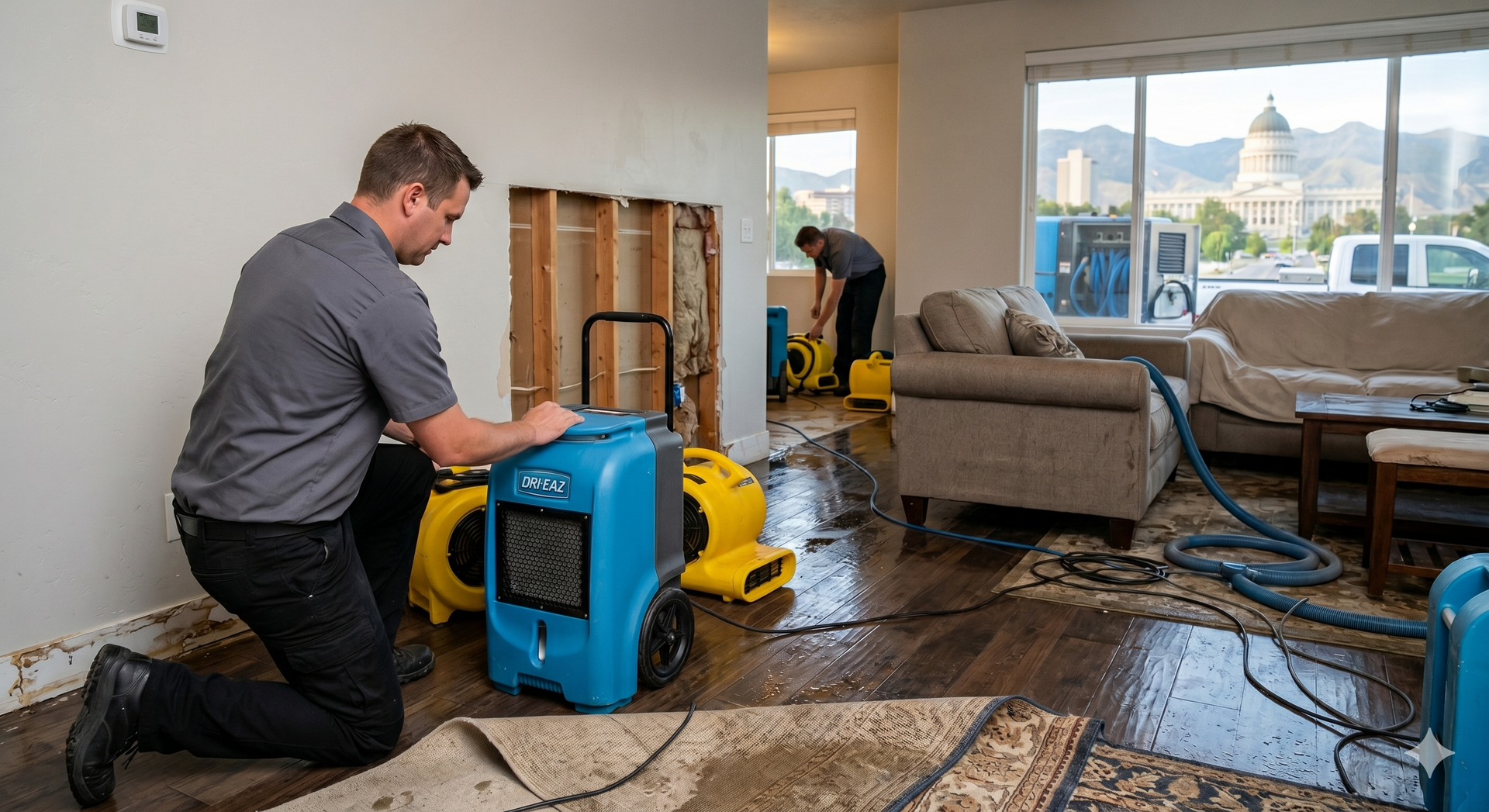
Water extraction: Industrial truck-mounted and portable extraction units remove standing water far more efficiently than consumer equipment. For major flood events, this phase may take multiple extraction passes before drying equipment can be effectively deployed.
Structural drying: Commercial-grade desiccant dehumidifiers and high-velocity air movers are positioned throughout the affected structure to draw moisture out of walls, subfloors, framing, and concrete. In Northern Utah's climate, thorough structural drying after a major event typically takes five to seven days, with daily moisture readings tracking progress.
Contaminated material removal: Drywall, insulation, carpet, and flooring that have been in contact with Category 3 floodwater are removed to the flood line—typically 12 to 24 inches above the watermark—to ensure all contaminated and moisture-compromised material is extracted.
Antimicrobial treatment: All remaining structural surfaces are treated with EPA-registered antimicrobial agents to address contamination and suppress mold growth before reconstruction begins.
Reconstruction coordination: Following successful drying and decontamination, the rebuild phase begins—replacing drywall, flooring, insulation, and finishes. Full-service flood cleanup services that include both mitigation and reconstruction eliminate the coordination gap between the two phases and reduce overall recovery time.
Mold Prevention During and After Utah Disaster Cleanup
Mold is among the most significant secondary risks in any large-scale water event, and it's one of the areas where Utah homeowners are sometimes caught off guard. The state's low ambient humidity can create a false sense of security—the assumption that the dry air will take care of moisture problems on its own.
In reality, mold grows in materials, not in air. Wood framing, drywall, and insulation that remain above 19% moisture content will support mold growth regardless of how dry the surrounding air feels. This is why professional moisture verification—using calibrated meters that measure inside materials, not just surface conditions—is an essential component of Utah disaster clean up rather than an optional add-on.
After any major flood event, homes in communities like Ogden, Layton, and Logan should be inspected for mold development four to six weeks after restoration work is completed. Mold that wasn't present immediately after the event can develop as residual moisture slowly equilibrates through building materials. A follow-up inspection provides a final verification that the flood damage restoration was complete.
Navigating Insurance Claims for Disaster-Level Water Damage
Insurance navigation after a major water event is one of the more stressful components of Utah disaster cleanup—and one where preparation and documentation make a significant difference. Standard homeowner's insurance covers sudden and accidental water damage from internal sources like pipe failures and appliance leaks, but typically excludes flooding from external sources such as rivers, storm drains, and surface runoff.
Flood damage from external sources requires separate flood insurance, typically through the National Flood Insurance Program (NFIP) or a private carrier. Many Northern Utah homeowners in areas that flooded during recent spring seasons discovered this gap after the fact. Reviewing coverage before the next significant event is a straightforward protective step.
For covered losses, the claims process benefits from detailed documentation, a professional damage assessment, and a written scope of flood damage restoration work from a licensed contractor. Restoration companies experienced with insurance documentation can substantially reduce the friction of the claims process by providing the structured reports and line-item estimates that adjusters need to approve claims efficiently.
Choosing Utah Disaster Cleanup Services: What to Look For
Not all restoration companies are equipped to handle the scale and complexity of major disaster response. When evaluating Utah disaster cleanup providers, the relevant criteria go beyond basic licensing and insurance.
Capacity matters in a major event. After a community-wide flooding scenario, demand for flood cleanup services in Salt Lake City, Ogden, and surrounding areas spikes simultaneously. A restoration company with sufficient staffing, equipment inventory, and logistics to manage multiple concurrent large-loss jobs is better positioned to respond promptly than a smaller operation working beyond its capacity.
Look for providers who follow Institute of Inspection Cleaning and Restoration Certification (IICRC) standards—the industry benchmark for water damage restoration procedures, documentation, and equipment use. IICRC-compliant flood damage restoration is conducted to a defined standard of care, not to whatever level the crew decides is sufficient on a given day.
Local presence and familiarity with Northern Utah infrastructure, soil conditions, and seasonal flooding patterns is also a meaningful differentiator. A restoration team that understands the specific ways spring runoff affects Wasatch Front neighborhoods—which areas flood first, how long water typically sits, where drainage challenges are most common—brings practical expertise that supports faster, more accurate scoping from the initial assessment.
Recovery Is a Process—Start It Well
Utah disaster cleanup is rarely a quick job. Major water events involve days of extraction and drying, weeks of reconstruction, and months of monitoring and normalization. But the quality and completeness of the work done in the first 48 hours shapes everything that follows—the mold risk, the structural integrity of the repair, the insurance outcome, and ultimately how fully the home is restored.
For Northern Utah homeowners, having a trusted local flood damage restoration provider identified before a disaster occurs is one of the most practical forms of preparedness available. When the call needs to be made at 11pm after water starts rising in the basement, knowing exactly who to call—and having their number saved—removes one decision from a very long list of urgent ones.
You might also like
Utah Flood Guys Blog